Swift 1.5 27B and Mellum 2.1 12B: Local AI Coding Models
It’s amazing how quickly the local agentic arena has changed this year. There are rumors that Qwen 4 will come out soon, and lots of people are buying crazy mini PCs for AI with unified memory and everything else. I’m not convinced that this is super productive, but it is definitely fun to watch and try every new thing that pops up.
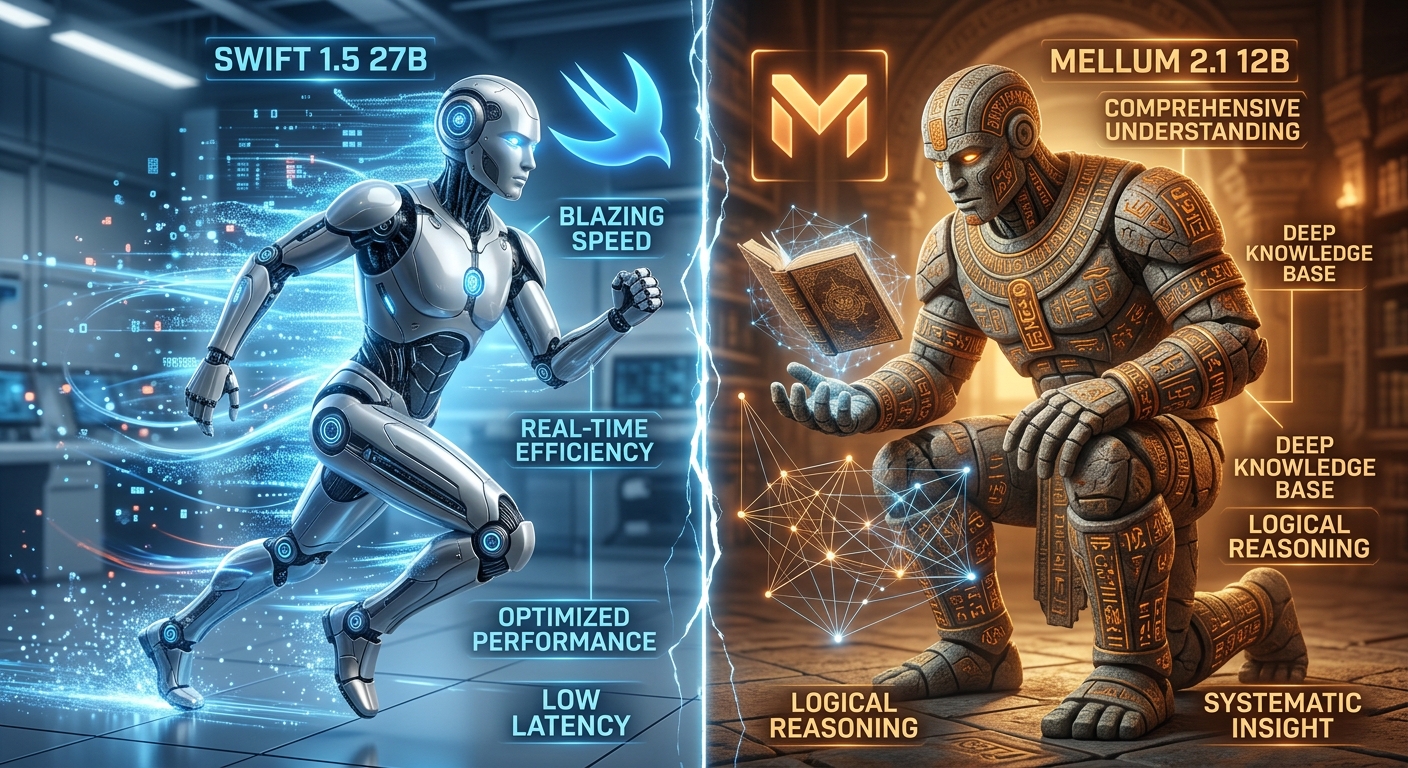
October Surprises
Swift 1.5 27B
When Qwen 3.8 27B was released, the community praised it for its amazing agentic abilities and compared it to Opus 4.6. It’s of course different, but the sentiment proved true for me: it’s a great local model for coding. I’ve developed a simple workflow where I plan a task and let the model chug away while I’m doing other things (like sleeping). However, it is so wordy. Its overthinking is great for problem-solving, but excessive in every way. Finally, someone decided to fine-tune this behavior out of it, and Swift 1.5 showed up! I’m using this specifically:
Swift-1.5-Qwen3.8-27B-UD-IQ4_XS.gguf
It fixes the overthinking very well, still writes great code, and is actually faster than the model I was previously using. Since it is smaller, I could bump up the context to 100K, which is a very usable context window for OpenCode.
Mellum 2.1 12B
The other October surprise came from JetBrains. They had released 2.0 earlier this summer and, to be honest, it wasn’t great for agentic loops. However, their post-trained version 2.1 is fairly impressive for what it is.
Mellum2.1-12B-A2.5B-Thinking-Q6_K.gguf
It is very fast (even without MTP, which isn’t released yet), thanks to its MoE architecture. It can really be run at 131K context which makes it very useful. Other local models just choke at that level. It can handle agentic coding loops and iterate on a problem well.
I view these two models as a fairly well-paired set. Swift 1.5 makes for a great planner, architect, and problem solver, and Mellum 2.1 can churn out the easy code and work through a well-defined backlog. Now, if only I could load them both at the same time.
Of course, the hero image for this post was AI-generated. It’s fun to see how far models have come, yet a frontier-level model generated a totally incorrect hero image for this post. I left it as a reminder that these generative transformers are—after all—token-prediction engines that perform massive matrix multiplications to predict the next token. They are amazing in many ways, but I will leave it to you to decide what intelligence really means in today’s world.